HSA Last-Month Rule: Full Limit From Dec 1
Here is a rule that rewards people who changed health plans late in the year, and punishes people who use it casually. If you are an eligible individual on December 1, the tax code treats you as if you were eligible all year for HSA contribution purposes. That one date can turn a few hundred dollars of contribution room into the full annual limit. I am walking through the math with two worked examples, because the benefit and the risk are both just arithmetic.
The official limits this rule uses
The IRS inflation-adjusted amounts for 2026, in Rev. Proc. 2025-19, set the annual HSA contribution limit at $4,400 for self-only coverage and $8,750 for family coverage. The same procedure defines a qualifying high deductible health plan, for 2026, as a plan with a deductible of at least $1,700 self-only or $3,400 family, and out-of-pocket expenses capped at $8,500 or $17,000. You can read the full Rev. Proc. 2025-19 text if you want the primary source in one page. Those are the ceilings the last-month rule lets a late starter reach.
How the rule works, in one paragraph
Normally your limit is prorated: months of eligibility divided by 12, times the annual limit. The last-month rule overrides that. As a plain-English summary of the rule and its testing period explains, drawing on IRS Publication 969, if you meet every HSA eligibility requirement on December 1, you are treated as though you had coverage all twelve months. The trade is a testing period: you must remain an eligible individual from December 1, 2026 through December 31, 2027. Fail it for a reason other than death or disability, and the extra amount, the part only the rule allowed, goes back into your taxable income, plus an additional 10 percent tax on that amount.
Worked example 1: self-only, covered from October 1
You start a qualifying HDHP on October 1, 2026, with self-only coverage, and you are still eligible on December 1. That is 3 eligible months.
| Method | Calculation | 2026 limit |
|---|---|---|
| Prorated | $4,400 x 3 / 12 | $1,100 |
| Last-month rule | Full annual limit | $4,400 |
| Extra room the rule creates | $4,400 - $1,100 | $3,300 |
If you contribute the full $4,400 and then lose eligibility during the testing period, that $3,300 difference is added to income, with a 10 percent additional tax of $330 on top of your normal tax on it. The $1,100 you could have contributed anyway is not the problem. Only the rule-created slice is.
Worked example 2: family, covered from September 1
Family coverage starting September 1 gives 4 eligible months. Prorated, that is $8,750 x 4 / 12, which is $2,917 rounded. Under the last-month rule the limit is the full $8,750, so the rule creates $5,833 of extra room, and a failed testing period puts that $5,833 back into income plus about $583 of additional tax. Employer contributions count toward whichever limit applies, so subtract what your employer put in before you top up your side. This is the same total-cost discipline I used in my HDHP versus PPO comparison for 2027: count every dollar that shares the cap.
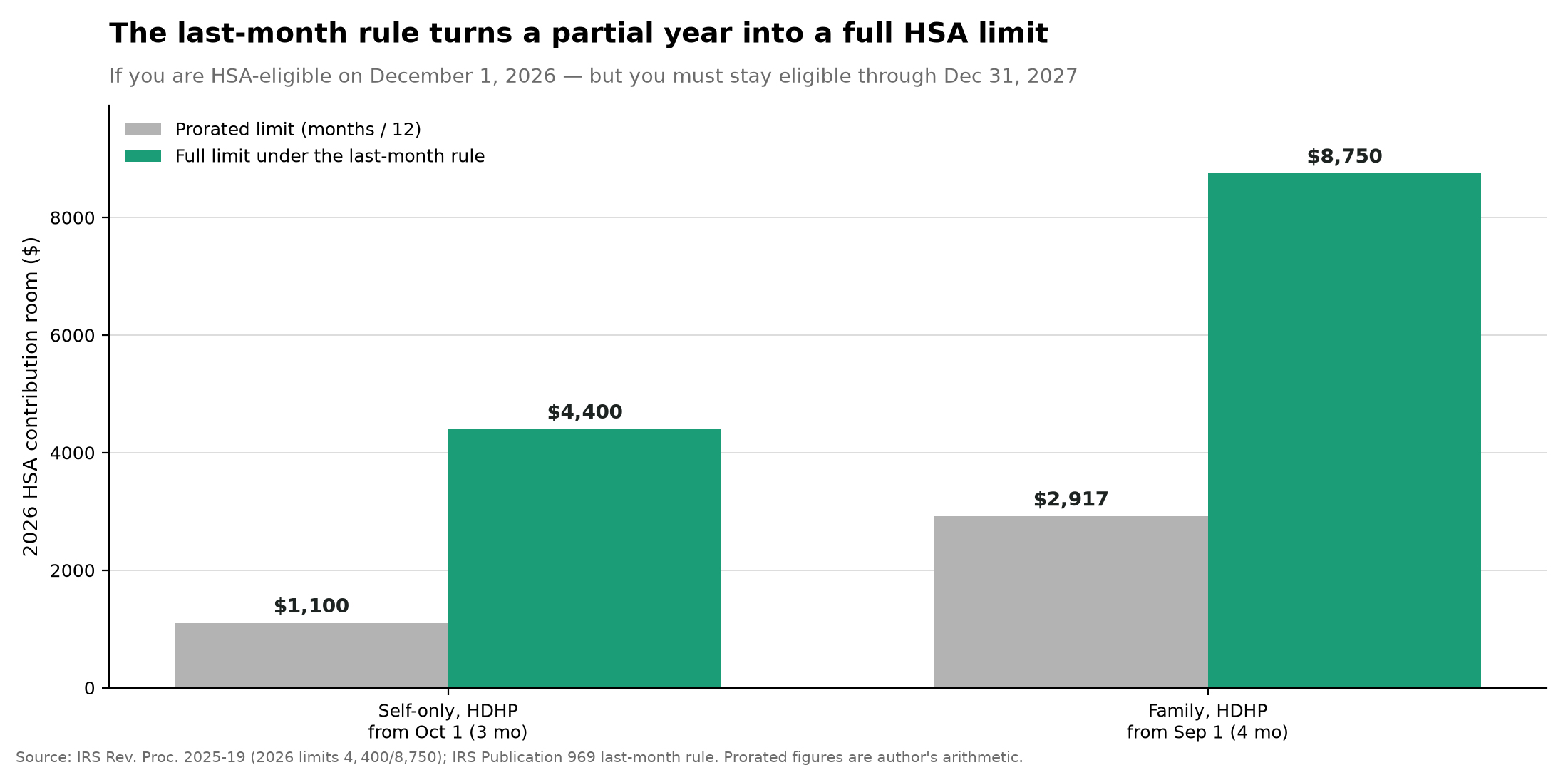
Figure: Prorated versus full limits in the two worked examples. Source: IRS Rev. Proc. 2025-19; IRS Publication 969 last-month rule; prorated figures are the author's arithmetic.
My decision checklist before using it
I would use this rule only if I expect to stay in a qualifying HDHP through all of 2027, with no planned move to a non-HDHP plan, no Medicare start, and no general-purpose flexible spending account in the household that would disqualify me. Contributions for 2026 can be made until the tax filing deadline in April 2027, so there is no need to rush the money in this week; there is a need to be honest about next year's coverage before claiming this year's full limit. If your income sits near a subsidy line, remember HSA contributions can also lower the income figure used elsewhere, a thread I followed in the ACA benchmark and cliff math. And if you are racing a different December wall, the 401(k) gap math is the companion worksheet. Different account, same lesson: the calendar, not your intention, decides what counts.
FAQ
What exactly has to be true on December 1, 2026? You must be an HSA-eligible individual on that date: enrolled in a qualifying HDHP, with no disqualifying other coverage, not enrolled in Medicare, and not claimable as someone else's dependent. Eligibility on December 1 is the trigger for the full-year treatment.
How long is the testing period, exactly? From December 1, 2026 through December 31, 2027, about 13 months. You must remain an eligible individual for that whole period, with exceptions only for death or disability.
What happens if I fail the testing period? The amount you contributed that was only allowed because of the last-month rule, the difference between your full contribution and your prorated limit, is included in your income for the year you fail, and an additional 10 percent tax applies to that amount. It is reported on Form 8889.
Do employer HSA contributions count against the full limit? Yes. The $4,400 and $8,750 limits cover you and your employer combined. Subtract employer contributions, including any seed money, before deciding your own top-up.
Can I wait until April 2027 to contribute for 2026? Generally yes, contributions designated for 2026 can be made until the tax filing deadline, but the December 1, 2026 eligibility and the testing period still govern how much you may contribute. Waiting to fund does not shorten the testing period.
Get the newsletter
New articles and the occasional deep dive. No spam.
Unsubscribe anytime. We never sell your email.