Finish Your 401(k) by Dec 31: The Gap Math Checklist
December 31 is the least forgiving deadline in personal finance. A 401(k) deferral counts for 2026 only if it comes out of a 2026 paycheck, which means the year does not end when you decide to act. It ends when your last paycheck runs. I do this math every November, on paper, in about ten minutes, and this year I am writing it down as the checklist I actually follow, because the difference between almost maxing out and maxing out is usually one worksheet, not one windfall.
Step 1: Start from the official limits, not a headline
The IRS announcement for 2026 (IR-2025-111, under Notice 2025-67) sets the numbers this checklist uses:
| 2026 limit (IRS) | Amount |
|---|---|
| Employee deferral, under 50 | $24,500 |
| Catch-up at 50 or older | +$8,000 (maximum $32,500) |
| IRA contribution limit | $7,500 |
One caution before any math: the 2027 limits have not been announced yet. As this tracker on the unannounced 2027 limits notes, the announcement is expected in mid-November, and last year's came on November 13, 2025. Anything you have seen presented as a confirmed 2027 figure is a projection. Plan 2026 with 2026 numbers, which are official, and revisit 2027 when the IRS publishes.
Step 2: Pull your real year-to-date number
Do not estimate this from memory, because memory is where this exercise usually fails. Get the year-to-date elective deferral figure from your most recent pay stub or your plan's website, and write it here:
- My deferrals so far in 2026: $________
- My applicable limit (from the table above): $________
- My remaining paychecks in 2026, counted on a calendar, including any bonus check that carries a deferral election: ________
- My current per-paycheck deferral: $________
Counting paychecks deserves thirty honest seconds. Pay periods that end in December but pay in January generally count against the new year, because the deferral date is the pay date. If you are unsure which side of the line your last check falls on, ask payroll now, while there is still time to fix the answer. I ran a version of this check in my October 401(k) catch-up math, and the paycheck count was the step that changed my own result.
Step 3: Run the gap math
The formula is one line: (your limit minus your year-to-date deferrals) divided by your remaining paychecks equals the per-paycheck deferral you need. Here it is worked at five common starting points for a worker under 50 aiming at $24,500, with exactly 4 paychecks left. The per-paycheck figures are my arithmetic from the IRS limit.
| Deferred so far | Gap to $24,500 | Paychecks left | Needed per paycheck |
|---|---|---|---|
| $12,000 | $12,500 | 4 | $3,125 |
| $15,000 | $9,500 | 4 | $2,375 |
| $18,000 | $6,500 | 4 | $1,625 |
| $20,000 | $4,500 | 4 | $1,125 |
| $22,000 | $2,500 | 4 | $625 |
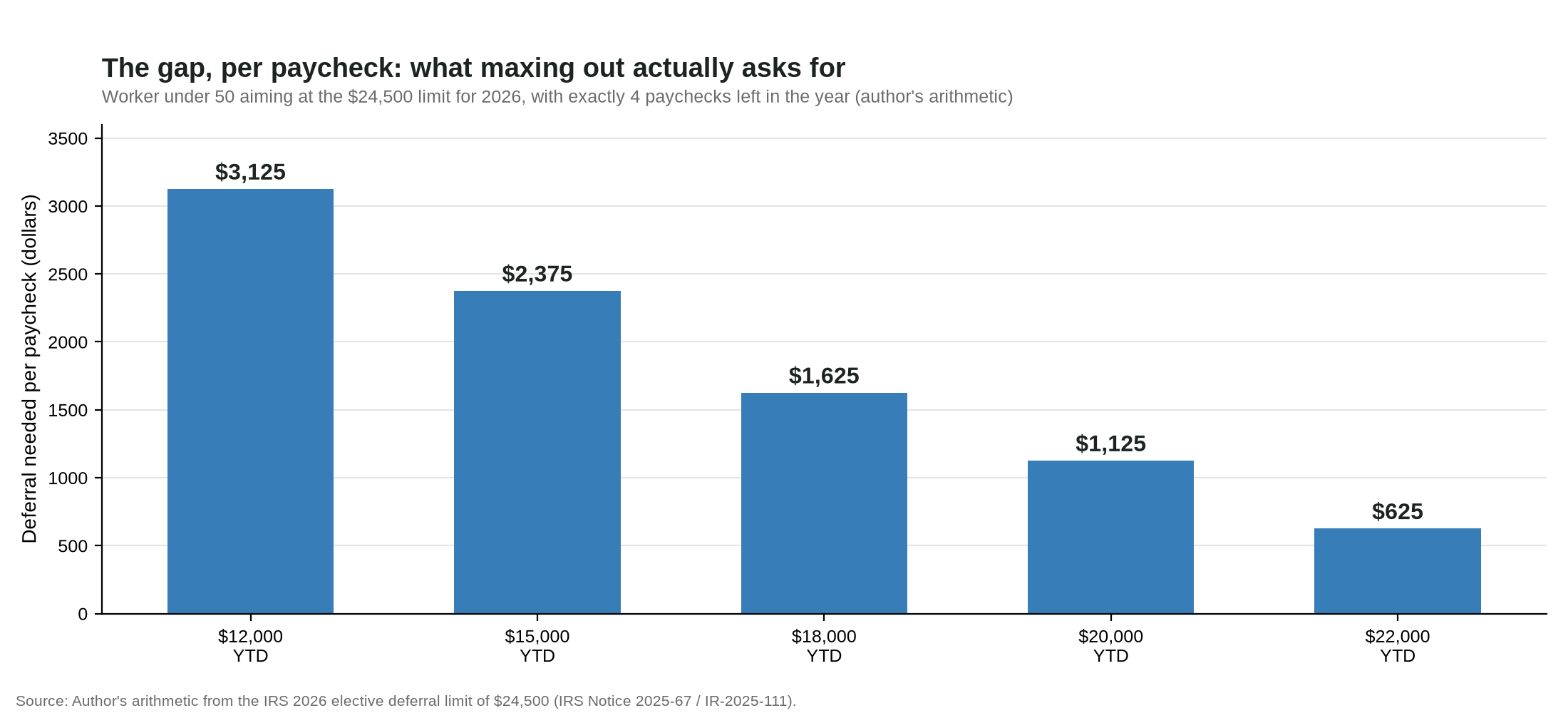
The gap per paycheck at five year-to-date levels, for a worker under 50 with 4 paychecks left. Source: author's arithmetic from the IRS 2026 limit of $24,500.
If you are 50 or older, run the same division against $32,500 instead. At $26,000 deferred so far, for example, your gap is $6,500 and the answer is the same $1,625 per paycheck over 4 checks, a coincidence that makes the table above do double duty.
Step 4: Convert dollars to the percentage your plan wants
Most plans take an election as a percentage of pay, not a dollar amount, so convert before you log in. On a hypothetical $3,000 gross paycheck, the $1,625 answer above is about 54 percent of pay, and the $625 answer is about 21 percent. Those are my divisions on an example paycheck, not your numbers: divide your per-paycheck target by your own gross pay and round up slightly, then check the rounding does not overshoot your limit in the final check. If your plan allows a flat dollar election, use it, because it removes the rounding problem entirely.
Step 5: File the change today, then verify it landed
- Submit the new election today, not after the next check. Many plans apply a change one or two pay periods later, so a change filed in mid-November may only catch your December checks.
- Confirm the new rate on the very next pay stub. An election you cannot see on a stub is an election that does not exist.
- Check that the higher deferral still leaves the match intact under your plan's rules, and that your take-home pay still covers December's bills. A maxed 401(k) alongside a credit-card balance is a trade, not a win.
- Set a January reminder to reset the rate, so a catch-up setting does not silently crowd out cash flow in the new year, and so you can re-run this math against the 2027 limits once they are official. I keep that reset with my other year-end money moves before December 31, and it pairs naturally with a Roth conversion bracket check if that is on your list.
The whole exercise is deliberately unglamorous: one official limit, one real year-to-date number, one honest paycheck count, one division. Do it this week and December becomes a verification, not a scramble.
Get the newsletter
New articles and the occasional deep dive. No spam.
Unsubscribe anytime. We never sell your email.