Roth Conversion Math: Fill the Bracket by Dec. 31
October is when a Roth conversion stops being an idea and becomes arithmetic with a deadline. A conversion counts for 2026 only if it is completed by December 31, 2026, according to IRS Publication 590-A. There is no April extension like the one for IRA contributions, and since the Tax Cuts and Jobs Act ended conversion recharacterization after 2017, there is no undo button either. That combination is actually a gift: it forces you to do the math now, while you still know roughly what your 2026 income is. Here is the math I run, with real 2026 brackets.
The only calculation that matters: room to the ceiling
The strategy is called filling the bracket. You estimate your taxable income before any conversion, then convert exactly enough to reach the top of your target bracket and no further. For 2026, under IRS Revenue Procedure 2025-32, the 12 percent bracket for married filing jointly tops out at $100,800 of taxable income, and the standard deduction is $32,200 for joint filers and $16,100 for single filers, whose 12 percent ceiling is $50,400. Say your projected taxable income before converting is $80,000 as a joint filer. Your room to the top of the 12 percent bracket is $20,800. Convert $20,800 and the federal tax on it is $2,496 at 12 percent. Convert the same $20,800 entirely inside the 22 percent bracket instead, because you misjudged your income, and the tax is $4,576. The overshoot penalty on that one slice is $2,080, which is real money for a paperwork error.
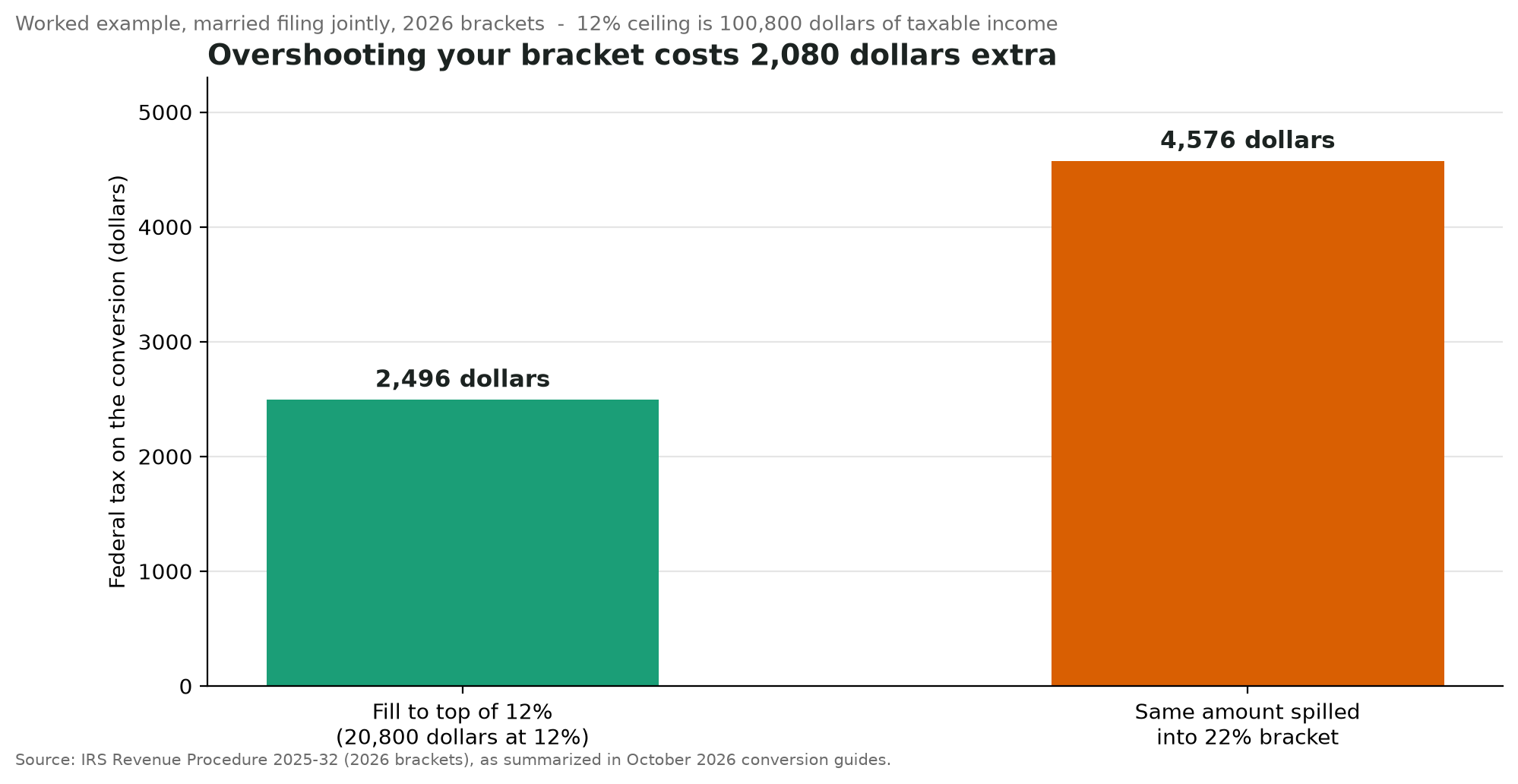
Tax on a $20,800 conversion slice at 12 percent versus 22 percent, married filing jointly, 2026. Source: IRS Revenue Procedure 2025-32.
Three traps that cost people money every December
First, withholding. The default withholding on an IRA distribution is 10 percent unless you elect otherwise on Form W-4R, and money withheld is money that never reaches the Roth. If you can, elect zero withholding and pay the tax from a regular bank account, so the full converted amount compounds tax-free; cover the bill with estimated payments, with the fourth-quarter payment due January 15, 2027. Second, the order rule: if you are 73 or older, your required minimum distribution must come out before any conversion in the same year, and RMD money cannot be converted. Third, the two-year shadow: conversion income raises your modified adjusted gross income, which can raise Medicare IRMAA premiums two years later, in 2028, and can shrink marketplace subsidies if you buy ACA coverage. None of these kill the strategy. All of them change the right conversion size, which is why the estimate happens in October, not on December 30.
How I sequence my own conversion
I project income in mid-October, convert about 90 percent of my calculated room then, and leave the last slice for mid-December when bonuses, dividends, and capital gains are mostly known. Custodians get slammed in the final week of December, so a conversion requested on December 29 is a conversion I do not fully control. Afterward, I keep the paper trail in one folder: Form 1099-R from the custodian, Form 5498 when it arrives in May, and Form 8606 Part II filed with my return. I also remember that each conversion starts its own five-year clock for penalty-free access to the converted principal. This is not personalized tax advice, and a CPA who runs conversion math every year is worth paying before a large conversion. But the bracket math above is the same math they will run, and now you can check it yourself.
FAQ
What is the deadline for a 2026 Roth conversion? The conversion must be completed by December 31, 2026, to count for the 2026 tax year, per IRS Publication 590-A. There is no extension to the April filing deadline.
Can I undo a Roth conversion if I change my mind? No. Recharacterization of conversions has not been allowed since the Tax Cuts and Jobs Act ended it after 2017, so size the conversion carefully before you submit it.
How much tax does a $20,800 conversion cost in the 12 percent bracket? At 12 percent it costs $2,496. The same amount taxed at 22 percent costs $4,576, a $2,080 difference, using the 2026 brackets in IRS Revenue Procedure 2025-32.
Should I have tax withheld from the conversion? Electing zero withholding and paying from non-retirement funds keeps the full amount inside the Roth. The default is 10 percent withholding on Form W-4R, and withheld money is not converted.
Get the newsletter
New articles and the occasional deep dive. No spam.
Unsubscribe anytime. We never sell your email.