Part D 2027: The $2,400 Cap Math, Worked
Medicare open enrollment runs from October 15 to December 7, and the two Part D numbers that matter for 2027 are already final, not projected. The Centers for Medicare and Medicaid Services set them on April 6, 2026: the standard deductible rises from $615 to $700, and the annual out-of-pocket cap on covered drugs rises from $2,100 to $2,400, as summarized in this plain-language explainer of the 2027 cap and walked through in this 2027 Part D check-your-prescriptions guide. I worked two full drug years below, because the headline "$300 more" is true for one kind of reader and irrelevant to another. If you are still comparing whole plans, start with our Medicare Advantage exits guide and then come back here for the drug math.
The two numbers, side by side
| Part D standard benefit | 2026 | 2027 | Change |
|---|---|---|---|
| Standard deductible | $615 | $700 | +$85 (+13.8%) |
| Annual out-of-pocket cap (covered drugs) | $2,100 | $2,400 | +$300 (+14.3%) |
| National base beneficiary premium (benchmark, not your premium) | $38.99 | $41.33 | +$2.34 |
Two cautions before any math. First, the deductible counts toward the cap; it is not $700 on top of $2,400. Second, premiums do not count toward the cap, and neither do drugs your plan does not cover or purchases you make with a discount card instead of your plan. Our open enrollment overview covers those plan-level traps in full.
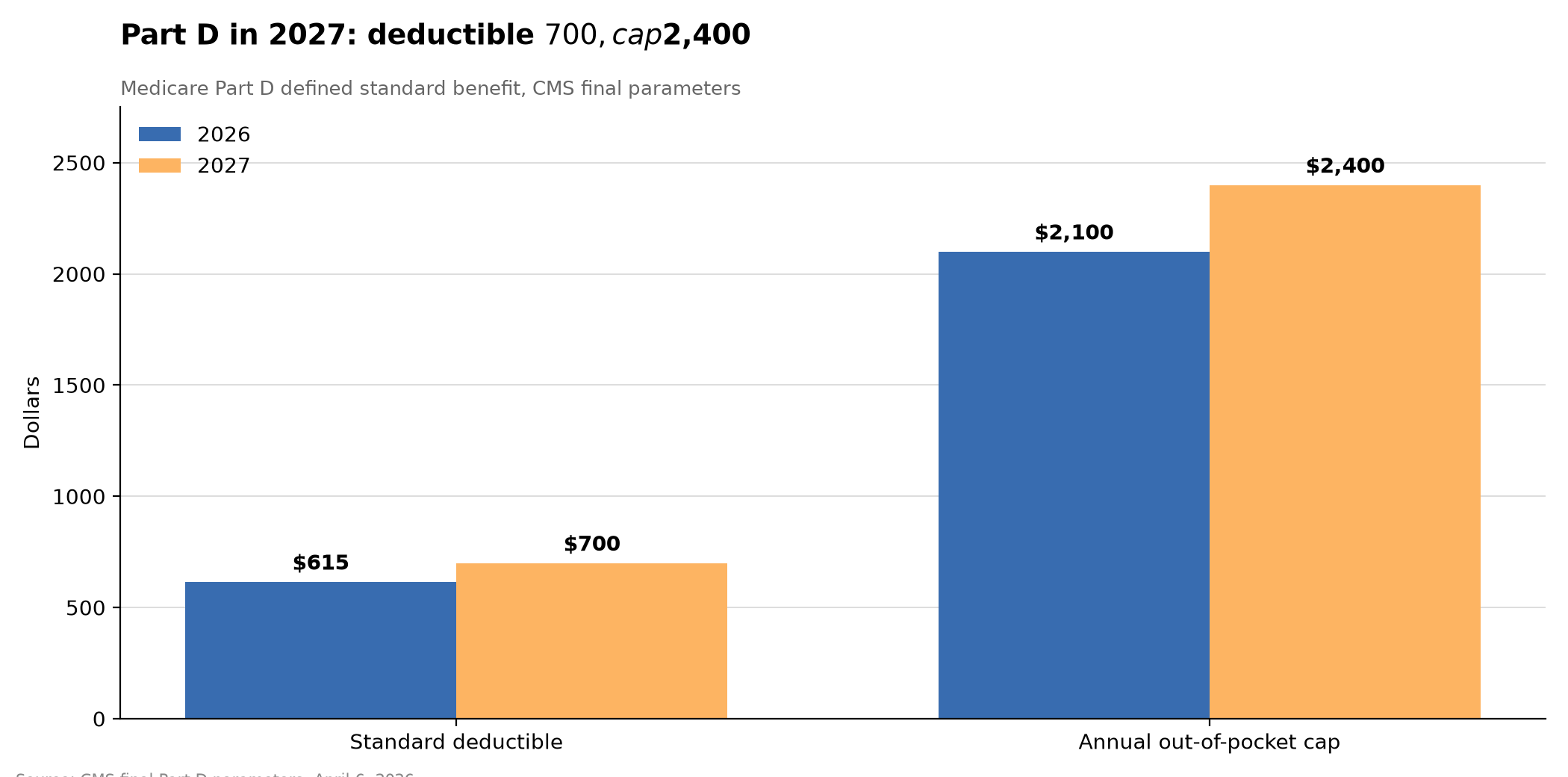
Figure 1: Part D standard deductible and out-of-pocket cap, 2026 vs 2027. Source: CMS final parameters, April 6, 2026.
Worked example 1: the $100-a-month drug
Take one covered drug that costs $100 a month before insurance, on the textbook standard benefit. In 2027 you pay the full $100 for seven months to meet the $700 deductible, then 25 percent, $25 a month, for the last five months. Your year totals $825. Run the identical drug through 2026 and you pay $615 of deductible plus 25 percent coinsurance for the rest of the year, $761.25 in total. The difference is $63.75, not $300, because a low-cost drug year never gets near either cap. Most readers with one or two generic prescriptions live in this example, and for them the 2027 change is a modest deductible problem, not a cap problem.
Worked example 2: the drug that hits the cap
Now take a covered specialty drug at $1,000 a month. You clear the $700 deductible in the first month, pay 25 percent coinsurance until your out-of-pocket total reaches the cap, and then pay nothing more for covered drugs that year. In 2026 that ceiling was $2,100. In 2027 it is $2,400, so this reader pays the full $300 increase, exactly the headline number. The practical move is unglamorous: add up your 2026 pharmacy receipts. If they crossed $2,100, budget $2,400 for 2027 and check whether the optional Medicare Prescription Payment Plan, which spreads out-of-pocket drug costs into monthly bills without reducing the total, helps your cash flow. If your receipts were under $1,000, shop on premium and formulary instead, using the same total-cost discipline as our FSA vs HSA math.
What to do before December 7
Pull your Annual Notice of Change, list every prescription with its tier, and run your exact drugs through the Plan Finder for 2027 rather than trusting the national averages, including the roughly $36 average stand-alone Part D premium CMS published in September. The cap protects you only on covered drugs, so a formulary change that drops your drug matters more than either national number in this article. Do that check once, in writing, before the December 7 deadline, and you have done the only Part D homework 2027 actually requires.
Get the newsletter
New articles and the occasional deep dive. No spam.
Unsubscribe anytime. We never sell your email.