HDHP vs PPO for 2027: Run Total Cost, Not the Deductible
Every open enrollment, I watch smart people choose a health plan by comparing two numbers: the premium and the deductible. That comparison is rigged. The deductible is the scariest number on the HDHP page and, in most years, the one you never fully pay. What decides which plan costs less is total cost for the year: premiums, plus what you actually pay for care, minus employer HSA money, minus the tax you save on your own HSA contributions. This is a comparison piece, so I will run one family through three years of care, with every line shown. If your employer offered you the FSA side of this choice, my FSA vs HSA open enrollment math covers that fork.
The 2027 federal numbers first
An HSA only exists alongside a qualifying high-deductible plan, and the IRS sets those fences. Revenue Procedure 2026-24, released May 29, 2026, sets the 2027 HSA contribution limit at $4,500 for self-only coverage and $9,000 for family coverage, up from $4,400 and $8,750 in 2026, with the age 55 catch-up unchanged at $1,000. To qualify in 2027, a plan needs a deductible of at least $1,750 self-only or $3,500 family, and an out-of-pocket maximum no higher than $8,700 self-only or $17,400 family. Those HDHP caps are separate from the Affordable Care Act's general out-of-pocket cap, which is $12,000 self-only and $24,000 family for 2027.
| 2027 limit (IRS Rev. Proc. 2026-24) | Self-only | Family |
|---|---|---|
| HSA contribution limit | $4,500 | $9,000 |
| Minimum HDHP deductible | $1,750 | $3,500 |
| Maximum HDHP out-of-pocket | $8,700 | $17,400 |
The worked example: one family, two real-shaped plans
These plan terms are my worked example, labeled as such; plug your own employer's numbers into the same rows. Family coverage. The PPO costs $600 a month ($7,200 a year), with a $1,000 deductible, 20 percent coinsurance, and a $4,500 out-of-pocket maximum. The HDHP costs $360 a month ($4,320 a year), with a $3,500 deductible, the same 20 percent coinsurance, an $8,000 out-of-pocket maximum, and a $1,000 employer HSA deposit. The HDHP therefore starts the year $2,880 ahead on premiums and $1,000 ahead on the deposit: $3,880 before anyone sees a doctor.
| Year of care | HDHP + HSA total | PPO total | HDHP ahead by |
|---|---|---|---|
| Light: $900 of care, PPO copays $300 | $4,320 + $900 - $1,000 = $4,220 | $7,200 + $300 = $7,500 | $3,280 |
| Moderate: $5,000 of care | $4,320 + $3,800 - $1,000 = $7,120 | $7,200 + $1,800 = $9,000 | $1,880 |
| Worst: both hit the out-of-pocket max | $4,320 + $8,000 - $1,000 = $11,320 | $7,200 + $4,500 = $11,700 | $380 |
Check the moderate row, because it is the one people get wrong. On the HDHP, $5,000 of care means the $3,500 deductible plus 20 percent of the remaining $1,500, which is $300, for $3,800 out of pocket. On the PPO it is the $1,000 deductible plus 20 percent of $4,000, which is $800, for $1,800. The PPO wins the care line by $2,000 and still loses the year by $1,880, because it gave back $2,880 in premiums and the $1,000 deposit.
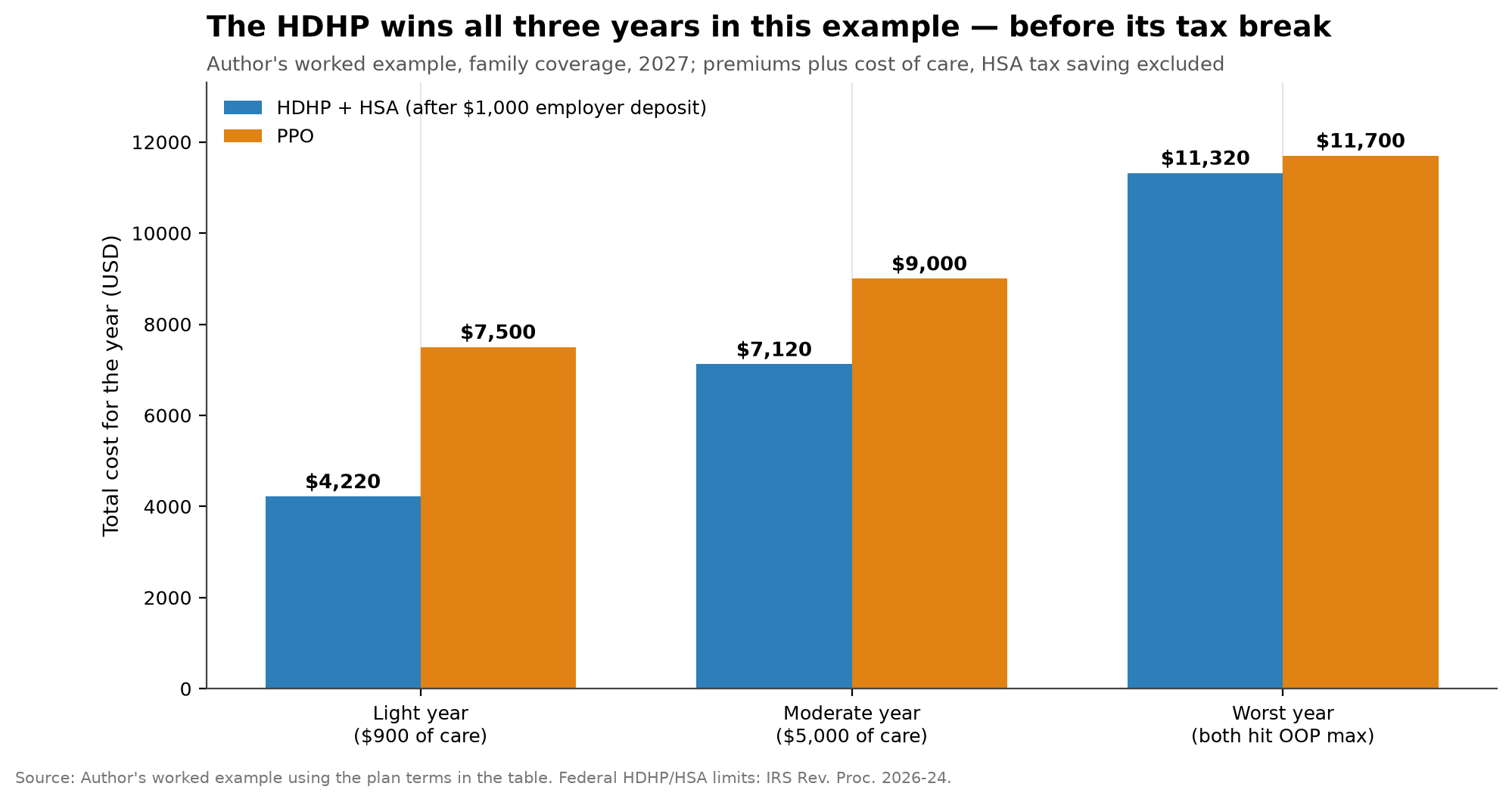
Total yearly cost in the worked example, three years of care. Source: Author worked example; federal limits from IRS Rev. Proc. 2026-24.
The tax line, and the honest caveats
None of the totals above count the HSA tax break. If this family contributes the $8,000 of its own money needed, with the employer's $1,000, to reach the $9,000 family limit, and sits in a 22 percent federal bracket, that is about $1,760 of federal income tax saved, which widens every HDHP margin above. Payroll contributions usually skip payroll tax as well. That is real money, and it is why I ran the comparison in my FSA spend-down math the same way: accounts you own beat balances you forfeit.
Now the caveats, because this example has a shape and yours may differ. If your employer's premium gap is small, say $60 a month instead of $240, the PPO can win the moderate and worst years; run your rows, not mine. Cash flow is real: on the HDHP, a February surgery means paying the deductible in February, so do not choose it until the HSA or a savings account can front that bill without a credit card. And networks and drug formularies are not in any table here; a plan that excludes your specialist is expensive at any premium.
FAQ
What are the HSA limits for 2027? $4,500 for self-only coverage and $9,000 for family coverage, plus $1,000 if you are 55 or older, under IRS Revenue Procedure 2026-24. Your plan must meet the HDHP tests: a deductible of at least $1,750 or $3,500, and an out-of-pocket maximum no higher than $8,700 or $17,400.
Is a high deductible always the real cost of an HDHP? No. You pay the deductible only on care you actually use, up to it. In a light year you may pay a few hundred dollars of it. Total cost for the year, premiums plus care minus HSA money and tax savings, is the comparison that matters.
When does the PPO win? When the premium gap is small, when you expect heavy care early in the year and cannot front the deductible, or when the PPO's network and drug coverage fit your actual doctors and prescriptions and the HDHP's do not. Run both plans through your own expected year before you decide.
Get the newsletter
New articles and the occasional deep dive. No spam.
Unsubscribe anytime. We never sell your email.