Holiday Funding Compared: Save, Charge, or Drift
The holiday season, by the National Retail Federation's definition, starts tomorrow, November 1, and its forecast says November and December retail sales will rise 4.2 percent to $1.013 trillion, the first trillion-dollar season in its measure, according to Reuters' report of the NRF forecast. What a household actually plans to spend is a smaller and more useful number: Deloitte's survey of about 4,000 consumers puts average planned holiday spending at $1,654, up 4 percent, split between $988 of retail goods and $666 of holiday experiences, in the same Reuters reporting. I do not care which funding method feels virtuous. I care what each one charges, so here is the same $1,654 season bought three ways.
The three funding routes, priced
Every card figure below is my own amortization calculation at a stated scenario rate of 24 percent APR, because card rates vary and the ranking does not: check your own statement rate and the shape of the result holds at any double-digit APR.
| Route | How it works | Total paid | Extra cost |
|---|---|---|---|
| Save first | Sinking fund: $1,654 set aside before you spend it | $1,654 | $0 |
| Charge and clear in 12 | Card, then 12 fixed payments of $156.40 | $1,877 | $223 interest |
| Charge and drift | Card, then $50 a month until it clears (about 55 months) | $2,736 | $1,082 interest |
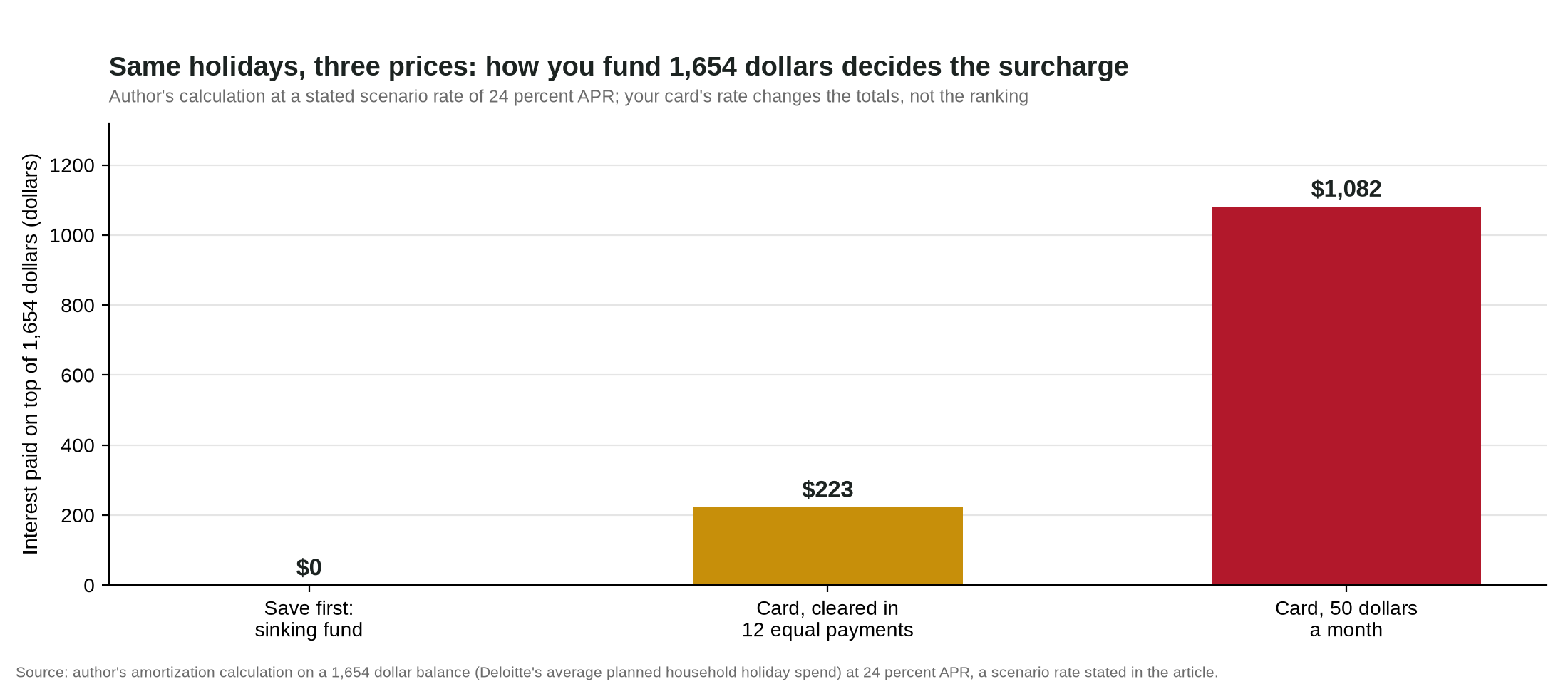
Figure 1: Interest paid on a $1,654 balance at a scenario rate of 24 percent APR. Source: author's calculation; spending figure from Deloitte via Reuters.
The drift route deserves a second look, because $50 a month sounds responsible. At 24 percent APR, the first month's interest on $1,654 is about $33, so only $17 of that $50 touches the balance. That is why the payoff takes roughly four and a half years and why the interest bill reaches 65 percent of the original season. The 12-payment route costs real money too, $223, but it is a bounded cost with an end date. The difference between the two card routes is not discipline in the abstract. It is $859, from one decision: a fixed payment sized to a deadline, versus a round number that feels comfortable.
The save-first route is still open, barely
Saving $1,654 between now and late December means about $207 a week for eight weeks, which is a serious ask, and I am not going to pretend otherwise. The scaled versions are more realistic and still beat both card routes: fund only the $988 goods portion in cash, about $124 a week, and put experiences on the calendar only as the cash exists. My October holiday sinking fund walk-through covers the account mechanics; the point here is comparative. Every dollar moved from the drift column to the save column saves about 65 cents of future interest at this scenario rate, which is a better return than any cashback card is offering you. If last year's season is still on your card, this year's version of this article is my year-end money moves checklist instead: do not stack a second drift balance on the first.
What the forecasts actually change for your list
Two numbers from this year's forecasts are worth acting on. Online sales are projected at $275.1 billion for the season, per Adobe Analytics figures summarized in Hardware Retailing's forecast roundup, which means the drift route is one thumbprint away at all times; deleting saved card details from retail accounts is the single highest-value friction you can add this weekend. And with Black Friday on November 27 and Cyber Monday on November 30, the list has to exist before the sales do. Write the names, the per-person cap and the total cap now, while the total is still the $1,654 you chose rather than the $2,736 the drift route chooses for you.
My honest recommendation, by situation
If you have the cash flow, save first, even partially: a half-funded season ($827 saved, $827 charged and cleared in 12 payments of about $78) costs about $111 of interest on my scenario math, not $223, and every saved dollar removes its share of the surcharge entirely. If the season has to go on a card, set the payment the day the statement arrives, sized to a finish line you choose, and automate it so December's willpower is not part of the plan. What I would not do, at any income, is the drift route: it converts an eight-week season into a four-and-a-half-year subscription to it.
Get the newsletter
New articles and the occasional deep dive. No spam.
Unsubscribe anytime. We never sell your email.