Dependent Care FSA Jumps to $7,500 for 2026
Open enrollment packets bury the best news in the smallest print, so let me put it in the headline: the dependent care FSA limit is $7,500 for 2026, up from $5,000, according to IRS Publication 15-B for 2026. That cap had been frozen since 1986, per reporting on the change, which means most parents I know are still budgeting off a number from the year the cap was written. If your household pays for daycare, preschool, or before- and after-school care so you can work, this is the one election to recalculate this fall instead of copying last year's.
What changed, exactly
For 2026, an employee can generally exclude up to $7,500 a year under a dependent care assistance program, or $3,750 if married filing separately, up from $5,000 and $2,500, per IRS Publication 15-B (2026). Two rules did not change, and they decide whether the bigger cap helps you. First, it is a household limit, not a per-spouse limit: two working spouses cannot each elect $7,500 for the same household. Second, the exclusion cannot exceed the smaller of your earned income or your spouse's earned income, so a household with a non-working spouse generally cannot use it the usual way. The account is also use-it-or-lose-it with no carryover, unlike the health FSA, so the new room is only valuable on care you are confident you will actually pay for in the plan year.
What the extra $2,500 is worth in real money
Dependent care FSA dollars skip federal income tax and, under Publication 15-B, Social Security and Medicare tax as well. So the value of a full election is your marginal bracket plus 7.65 percent payroll tax, applied to the amount you run through the account. I ran the arithmetic at three common brackets:
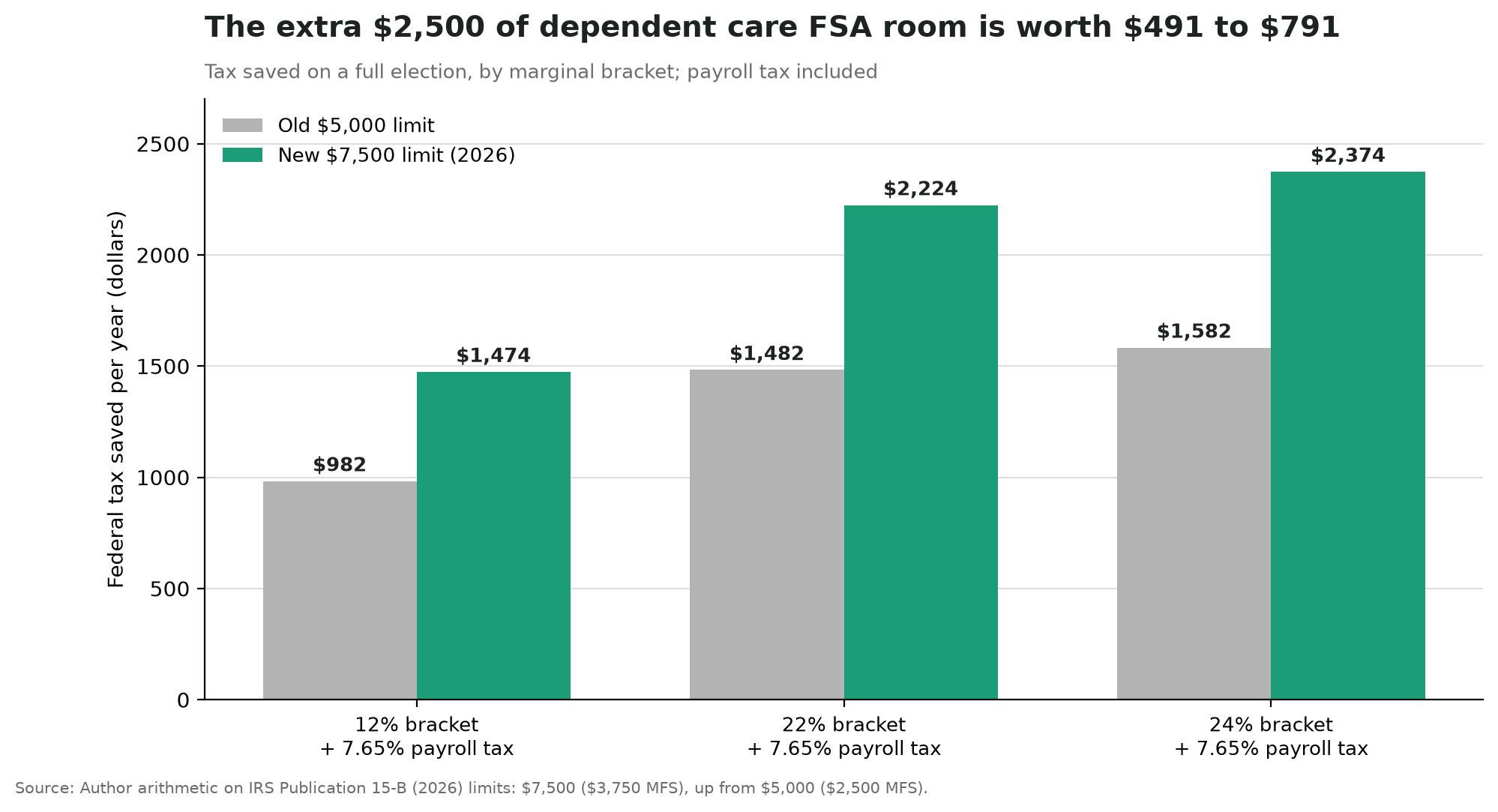
Tax saved on a full election under the old and new limits. Source: Author arithmetic on IRS Publication 15-B (2026) limits.
At the 22 percent bracket, a full $7,500 election saves about $2,224 a year, against about $1,482 at the old cap, a gain of roughly $742 for electing the room you were already spending on care. At the 12 percent bracket the gain is about $491, and at 24 percent about $791. Per month, the full election is $625 of pre-tax pay, and because the account is funded paycheck by paycheck rather than front-loaded, your reimbursements early in the year cannot outrun what you have actually contributed. Budget for that lag in January instead of being surprised by it.
Do not double-count the child care credit
The trap in a bigger FSA is the Child and Dependent Care Credit, claimed on Form 2441. The two benefits draw on the same pool of expenses, and every dollar you exclude through the FSA shrinks the expenses you can claim for the credit, whose expense ceilings remain $3,000 for one dependent and $6,000 for two or more, per IRS rules summarized in 2026 guidance. For most households with two children and $6,000 or more of care costs, the usual answer is: fill the FSA first for the payroll-tax saving, then claim the credit only on eligible expenses above what the FSA covered, up to the ceiling, if any room remains. Households in the lowest brackets should run both orders before electing, because a credit can beat an exclusion when your marginal rate is low. This is planning math, not tax advice; your plan document and a preparer settle your case. What I would not do is the default thing, which is to elect $5,000 out of habit in the first year the cap has moved in four decades.
FAQ
What is the dependent care FSA limit for 2026? $7,500 per household, or $3,750 if married filing separately, up from $5,000 and $2,500, according to IRS Publication 15-B (2026).
Can both spouses elect $7,500? No. The limit is a household cap for couples filing jointly, and the exclusion cannot exceed the smaller spouse's earned income, per Publication 15-B.
Does unused dependent care FSA money carry over? No. The dependent care FSA has no carryover, so unused funds are forfeited. Elect only what you are confident you will spend on qualifying care in the plan year.
Can I use the FSA and the child care credit together? Yes, but not on the same dollars. FSA-excluded expenses reduce the expenses eligible for the credit, which is capped at $3,000 of expenses for one dependent and $6,000 for two or more.
Get the newsletter
New articles and the occasional deep dive. No spam.
Unsubscribe anytime. We never sell your email.