I Bonds at 4.26%: Buy Before October 31?
Every six months, I bonds give savers a small, useful deadline, and the next one is October 31. According to the U.S. Department of the Treasury's TreasuryDirect announcement on May 1, 2026, Series I bonds issued from May 1 through October 2026 earn a composite rate of 4.26 percent for their first six months. On November 1, a new rate is set. If you want the known rate instead of the unknown one, you buy in October. Here is how I think through whether that is worth doing.
What 4.26 percent is actually made of
The TreasuryDirect announcement breaks the composite rate into two parts: a fixed rate of 0.90 percent, which stays with that bond for its life, and an inflation component based on the Consumer Price Index for All Urban Consumers. The announcement notes CPI-U rose 1.67 percent over the six months from September 2025 to March 2026, which annualizes to the inflation part of the 4.26 percent.
That fixed rate is the part I pay attention to. The inflation part changes every six months for every bond, old and new. The fixed rate does not. Two bonds bought in different windows can pay different amounts in the same future period purely because their fixed rates differ. Buying before October 31 locks the 0.90 percent fixed rate TreasuryDirect announced for this window. The November fixed rate could be higher, lower, or the same. Nobody honest can tell you which.
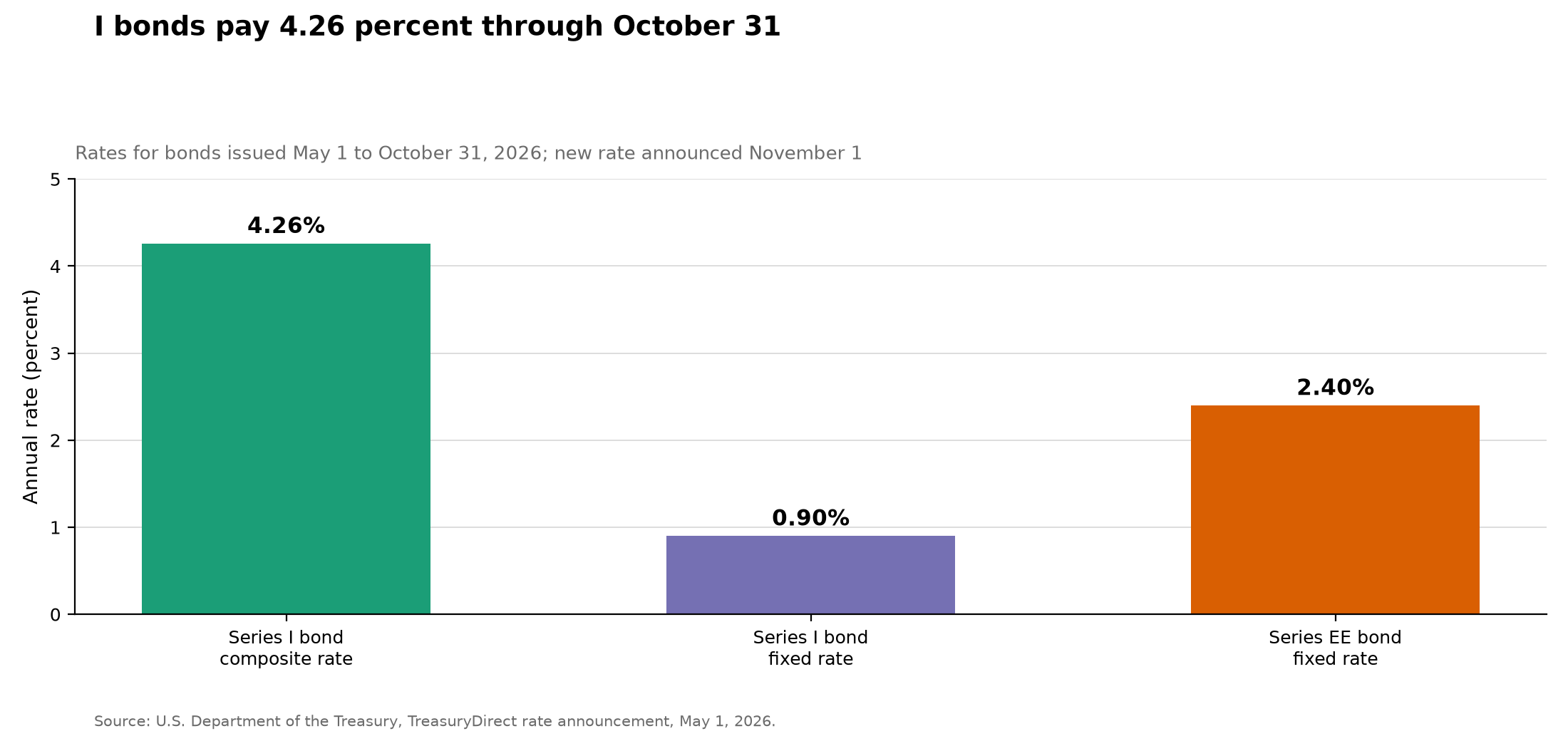
Figure: Current savings bond rates for bonds issued May 1 to October 31, 2026. Source: U.S. Department of the Treasury, TreasuryDirect, May 1, 2026.
The rules that decide if this fits you
TreasuryDirect's savings bond pages set out the constraints, and they matter more than the headline rate:
- Minimum purchase is $25, and you can buy any amount to the cent.
- The annual limit is $10,000 per person in electronic I bonds per calendar year.
- You cannot cash an I bond for the first 12 months. It is a genuine lock-up.
- If you cash in before five years, you lose the last three months of interest.
- Interest accrues monthly, compounds semiannually, and the bond earns for up to 30 years.
- Series EE bonds in the same window pay a fixed 2.40 percent, for comparison, and are guaranteed to double at 20 years.
That 12-month lock-up is my filter. Money I might need for a car repair, a move, or a job gap does not go into I bonds in October, whatever the rate. Money already sitting in savings for a goal more than a year away is a different conversation.
A worked example on $10,000
Keep this simple and honest. At a 4.26 percent composite rate for the first six months, $10,000 earns roughly $213 in that first half-year, before the rate resets. I say roughly because accrual and compounding are monthly and semiannual in the Treasury's method, not a single lump at month six.
If you cashed out at exactly 12 months, the three-month penalty would take back roughly a quarter's interest at whatever rate applied in those months. That is why I treat five years as the honest holding period and 12 months as an emergency exit, not a plan. Compared with leaving the same $10,000 in a savings account whose rate can be cut any week, the appeal is not excitement. It is that part of the return, the fixed rate, cannot be cut at all.
My decision framework
I ask three questions. Is this money I will not touch for at least a year, and ideally five? Have I already used this year's $10,000 limit? And am I comfortable that the November rate might turn out better, making my October buy merely good rather than perfect? If the answers are yes, no, and yes, buying before October 31 is a reasonable, boring move. Boring is a compliment in this category.
One practical warning: TreasuryDirect is the only place to buy electronic I bonds, its account setup takes a little patience, and late-October is exactly when everyone else remembers the deadline. If you are opening a new account, do it this week, not on October 31.
FAQ
What is the current I bond rate? 4.26 percent composite for bonds issued May 1 through October 31, 2026, including a 0.90 percent fixed rate, per TreasuryDirect's May 1, 2026 announcement.
When does the I bond rate change? New rates are announced every May 1 and November 1. Buying by October 31 gets the current window's fixed rate.
How much can I buy? Up to $10,000 per person per calendar year in electronic I bonds, with a $25 minimum, according to TreasuryDirect.
Can I cash out early? Not in the first 12 months. Cashing before five years costs the last three months of interest.
How do EE bonds compare right now? EE bonds issued in this window pay a fixed 2.40 percent and are guaranteed to double in value at 20 years, per TreasuryDirect.
Get the newsletter
New articles and the occasional deep dive. No spam.
Unsubscribe anytime. We never sell your email.