Appeal Your IRMAA Surcharge With Form SSA-44
The most expensive letter in retirement looks like routine paperwork. Your Medicare premium for 2026 is set by your 2024 tax return, a two-year lookback the Social Security Administration uses to calculate the Income-Related Monthly Adjustment Amount, or IRMAA. If you retired, divorced, or lost a spouse or a pension since 2024, that old return describes a person who no longer exists, and you may be paying a surcharge for income you no longer have. There is a specific form that fixes it, and in my experience almost nobody files it.
The cliff, in real numbers
IRMAA has no phase-in. For 2026, single filers at or below 109,000 dollars of modified adjusted gross income in 2024 pay the standard Part B premium of 202.90 dollars a month, according to the Centers for Medicare and Medicaid Services premium tables. One dollar over that line moves you to the first tier at 284.10 dollars a month. The tiers keep climbing: 405.80, 527.50, and 649.20 dollars, up to 689.90 dollars at the top tier for single income of 500,000 dollars or more. Part D adds its own surcharge on top, from 14.50 dollars up to 91.00 dollars a month. For a couple who both pay it, a single missed tier is worth roughly 1,950 dollars a year in Part B alone. That is the math that makes one form worth an afternoon.
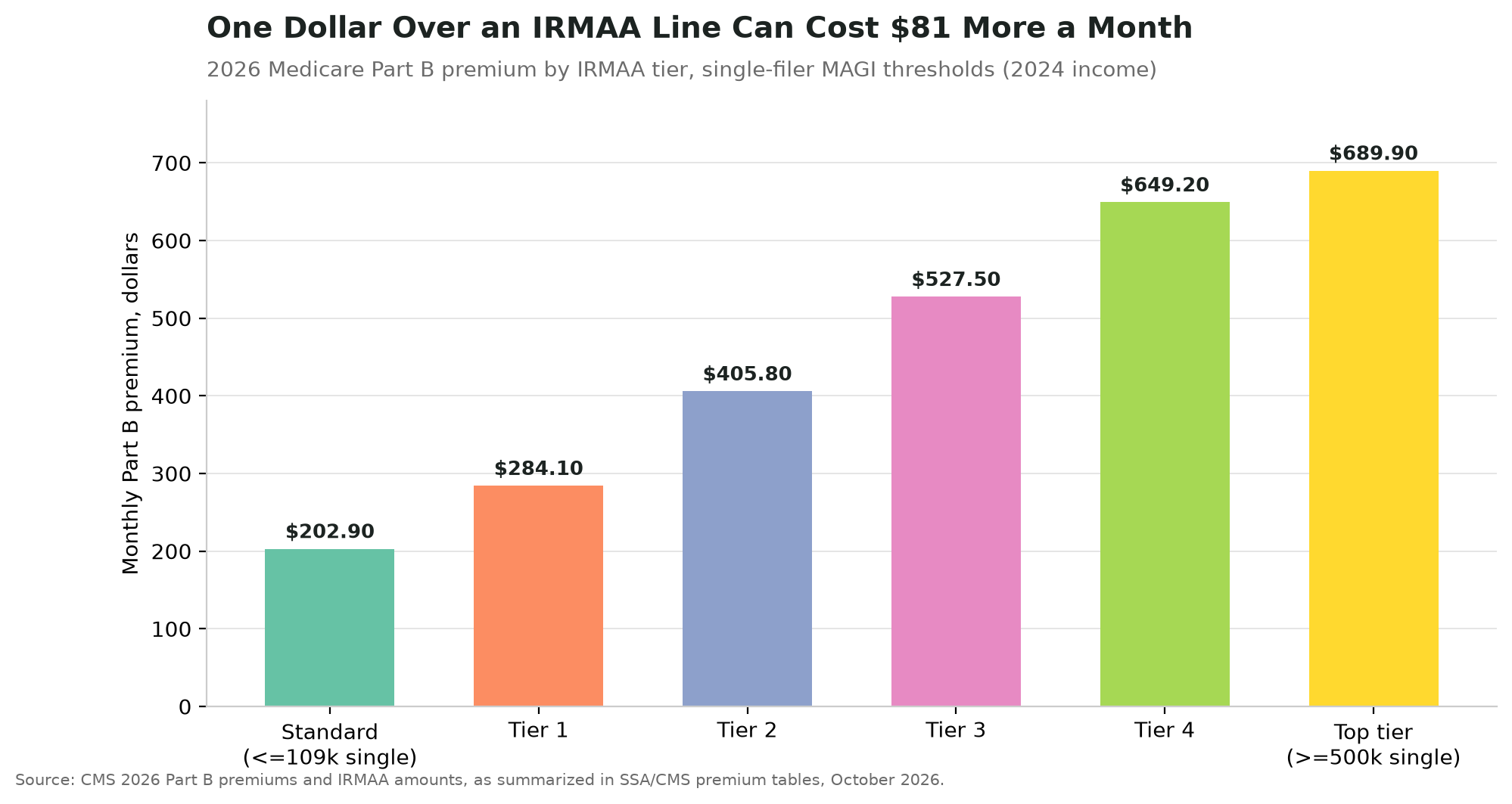
Figure 1: 2026 monthly Part B premium by IRMAA tier. Source: CMS 2026 Part B premiums and IRMAA amounts, summarized in SSA/CMS premium tables.
The seven events that qualify you to appeal
Social Security does not accept "my income went down" as an argument. It accepts specific life-changing events, documented, under Form SSA-44. The qualifying events are: marriage; divorce or annulment; death of a spouse; work stoppage, which includes retirement; work reduction; loss of income-producing property not caused by a sale; and loss or reduction of certain pension income, plus an employer settlement tied to a closure or reorganization. Retirement is the big one. If you worked through 2024 and retired in 2025, your lookback year is exactly wrong, and you are the person this form was written for. Note what is not on the list: a voluntary stock sale or a one-time Roth conversion does not qualify, because the drop has to come from the event, not from a transaction you chose.
How I would file it, step by step
First, download Form SSA-44 from the Social Security Administration and read its documentation table before you fill in a single box, because each event wants different proof: a marriage certificate, a death certificate, an employer letter confirming your last day, a pension statement showing the reduction. Second, estimate your current-year income honestly and write it where the form asks; Social Security will reconcile against your actual return later, and an appeal built on a guess you cannot support will unwind. Third, file promptly. You generally have 60 days from the date on your IRMAA notice to request reconsideration, and sooner is better either way. Fourth, submit it to your local Social Security office by mail, fax, or in person, and keep a complete copy. If the appeal is approved, the lower premium applies going forward and overpaid surcharges are refunded, according to Social Security's published process. October is the natural month to do this: open enrollment starts October 15, your Annual Notice of Change is already in hand, and the 2027 COLA announcement lands October 14, so every number you need is on the kitchen table at once.
Plan the reverse problem for 2028
The same lookback that hurts new retirees rewards planners. Your 2026 income sets your 2028 premiums, so a large Roth conversion, a business sale, or a big capital gain this year has a Medicare price tag arriving in two years, up to that 689.90 dollar tier plus the Part D surcharge. Before any large income event, compare the projected total against the tier thresholds, 109,000 and 218,000 dollars at the first step for single and joint filers, and ask whether splitting the event across two tax years keeps you a tier lower. This is general education about how the brackets work, not personal tax advice, and a large case deserves a professional's eyes. But the cheapest IRMAA appeal is the one you never need because you saw the cliff coming.
FAQ
What is IRMAA? The Income-Related Monthly Adjustment Amount: a surcharge added to Medicare Part B and Part D premiums when your income from two years earlier exceeds set thresholds.
Which income year sets my 2026 IRMAA? Your 2024 modified adjusted gross income. The standard 2026 Part B premium is 202.90 dollars a month at or below 109,000 dollars single or 218,000 dollars joint.
Who can file Form SSA-44? Anyone whose income dropped because of a qualifying life-changing event, including retirement, divorce, death of a spouse, or loss of pension income, with documentation.
How much could an appeal save? Dropping from the first tier back to standard saves 81.20 dollars a month on Part B alone, about 974 dollars a year per person, plus any Part D surcharge reduction.
What does not qualify for an appeal? Voluntary income changes such as selling stock or doing a one-time Roth conversion. The reduction must result from a listed life-changing event.
Get the newsletter
New articles and the occasional deep dive. No spam.
Unsubscribe anytime. We never sell your email.