Tax-Loss Harvesting in October: Do It Early
Every December, investors crowd into the same trade at the same time: selling losers in a rush, then discovering the wash-sale rule in January. October is when tax-loss harvesting actually works well. You have time to find a replacement holding you genuinely like, time to watch the 30-day window, and no holiday market hours working against you. I do my harvest in October for exactly those reasons, and here is the framework I use, built on the Internal Revenue Service rules.
What a harvested loss actually buys you
A capital loss in a taxable account first offsets capital gains, dollar for dollar. If losses exceed gains, you can deduct up to 3,000 dollars of the remainder against ordinary income in a year, or 1,500 dollars if married filing separately, and whatever is left carries forward to future years. That ordering is why harvesting is most valuable in a year when you already have gains: a short-term loss offsetting a short-term gain shields income taxed at your ordinary rate, which is the most expensive gain you own. In my worked example below, a 9,000 dollar loss against 5,000 dollars of gains deducts another 3,000 dollars of income and still banks 1,000 dollars for next year.
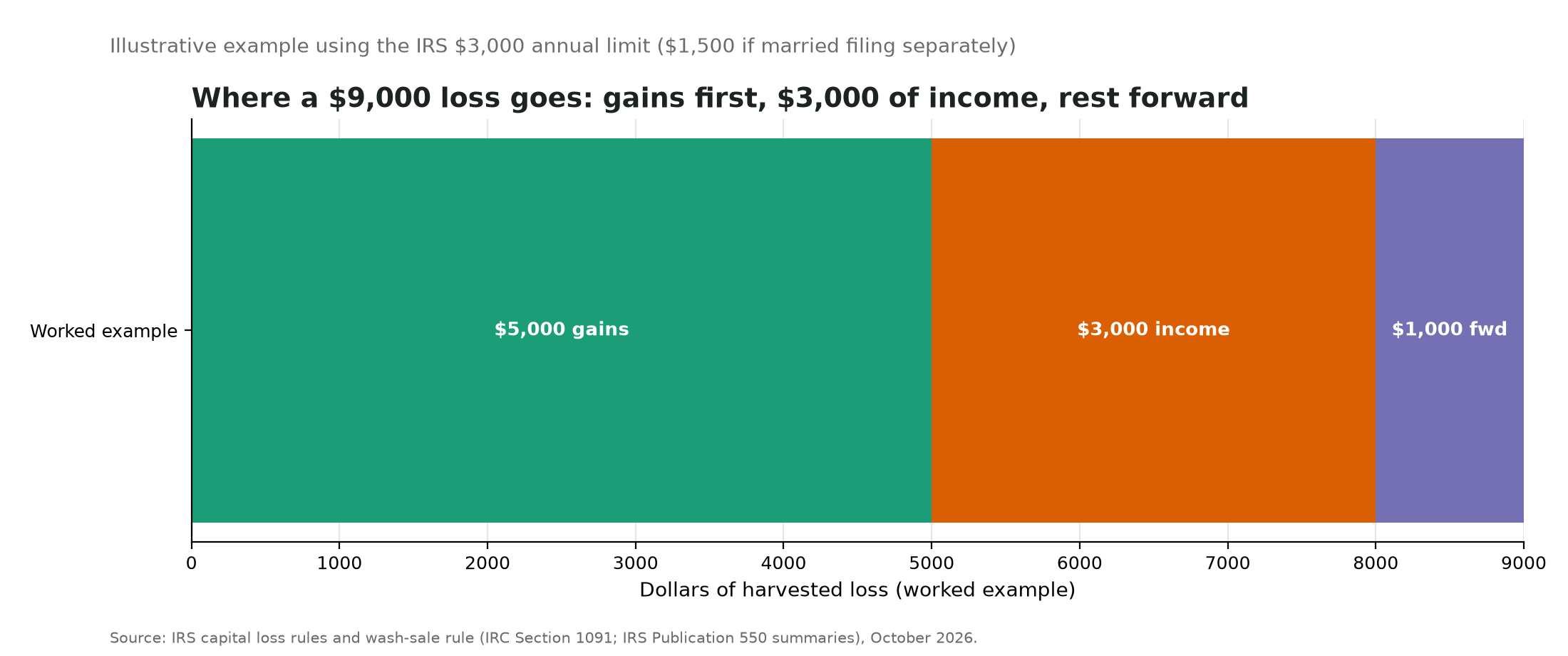
Figure 1: A worked example of the IRS ordering rules for a harvested loss. Source: IRS capital loss rules and the wash-sale rule, Internal Revenue Code Section 1091 and IRS Publication 550 summaries, October 2026.
The wash-sale rule, stated plainly
Under the wash-sale rule, if you sell a security at a loss and buy a substantially identical security within 30 days before or after the sale, the loss is disallowed for that year and added to the cost basis of the replacement shares. Count both directions and the sale day itself, and you are managing a 61-day window, not a 30-day one. The rule reaches across your accounts, including retirement accounts, which is the trap October timing helps you avoid: check dividend reinvestment settings and any automatic buys before you sell, not after. Doing this in October also means a sale today clears its window in November, leaving December free instead of fenced off.
My October procedure, step by step
First, I list every taxable holding trading below my cost basis and note whether the loss is short-term or long-term. Second, I total the gains I have already realized this year, because that number sets how much loss is immediately useful at the best rate. Third, for each sale I choose the replacement before I sell: a similar but not substantially identical fund, or a holding I would be content to keep permanently. Fourth, I turn off automatic reinvestment on anything related, in every account, and calendar day 31 as the earliest possible buyback date if I want the original back. Fifth, I write down each trade, its basis, and its window dates in one note my future self and my tax preparer can both read. None of this requires prediction. It is clerical work with a deadline, which is precisely why October beats December.
When not to harvest
Skip it in tax-advantaged accounts, where losses buy nothing. Skip it when the loss is tiny relative to trading costs and complexity. Skip it when the only replacement you can find is one you would not hold on its merits, because a tax benefit measured in hundreds is a bad trade for a portfolio position measured in years. And get a tax professional's eyes on any large or unusual case, options, or cross-account questions: I am describing the general IRS framework, not filing your return.
FAQ
What is the wash-sale window, exactly? Thirty days before the sale, the sale day, and thirty days after: 61 days total. Buying a substantially identical security inside it disallows the loss for that year, per Internal Revenue Code Section 1091.
How much loss can I deduct against my income? Up to 3,000 dollars a year after offsetting gains, or 1,500 dollars if married filing separately. Excess losses carry forward.
Does the rule apply to my IRA? Yes. Repurchasing the same security in a retirement account within the window can trigger the wash sale, and the loss treatment is worse there, so check every account before selling.
Why harvest in October instead of December? An October sale clears its 61-day window before year-end, replacement choices are unhurried, and you avoid the December crowd and holiday market schedule.
Can I buy something similar right away? Generally yes, if it is not substantially identical. Many investors swap to a fund tracking a different index. When in doubt on a large trade, ask a tax professional first.
Get the newsletter
New articles and the occasional deep dive. No spam.
Unsubscribe anytime. We never sell your email.