Working on Social Security? The $24,480 Earnings Test
October is when this rule quietly bites people. If you claimed Social Security before full retirement age and you are still working, the fall is when your year-to-date pay crosses the annual earnings limit, especially if you pick up holiday shifts or a year-end bonus lands. For 2026, the Social Security Administration's earnings limit for people under full retirement age all year is $24,480, and the rule is blunt: $1 of benefits is withheld for every $2 you earn above that limit. I run this math every fall for my own planning, because the withholding is not a small rounding error. At $40,000 of earnings, it is $7,760 of benefits held back in a year.
The 2026 numbers, exactly as SSA sets them
Three figures govern the test for 2026, all published by the Social Security Administration. First, the limit if you are under full retirement age for the whole year: $24,480, with $1 withheld per $2 earned above it. Second, the limit in the calendar year you reach full retirement age: $65,160, with a gentler $1 withheld per $3 above it, and only earnings before the month you reach full retirement age count. Third, from the month you reach full retirement age onward, there is no earnings limit at all. Wages and self-employment income count toward the test; pensions, investment income, and IRA withdrawals do not, per SSA's published guidance on the earnings test.
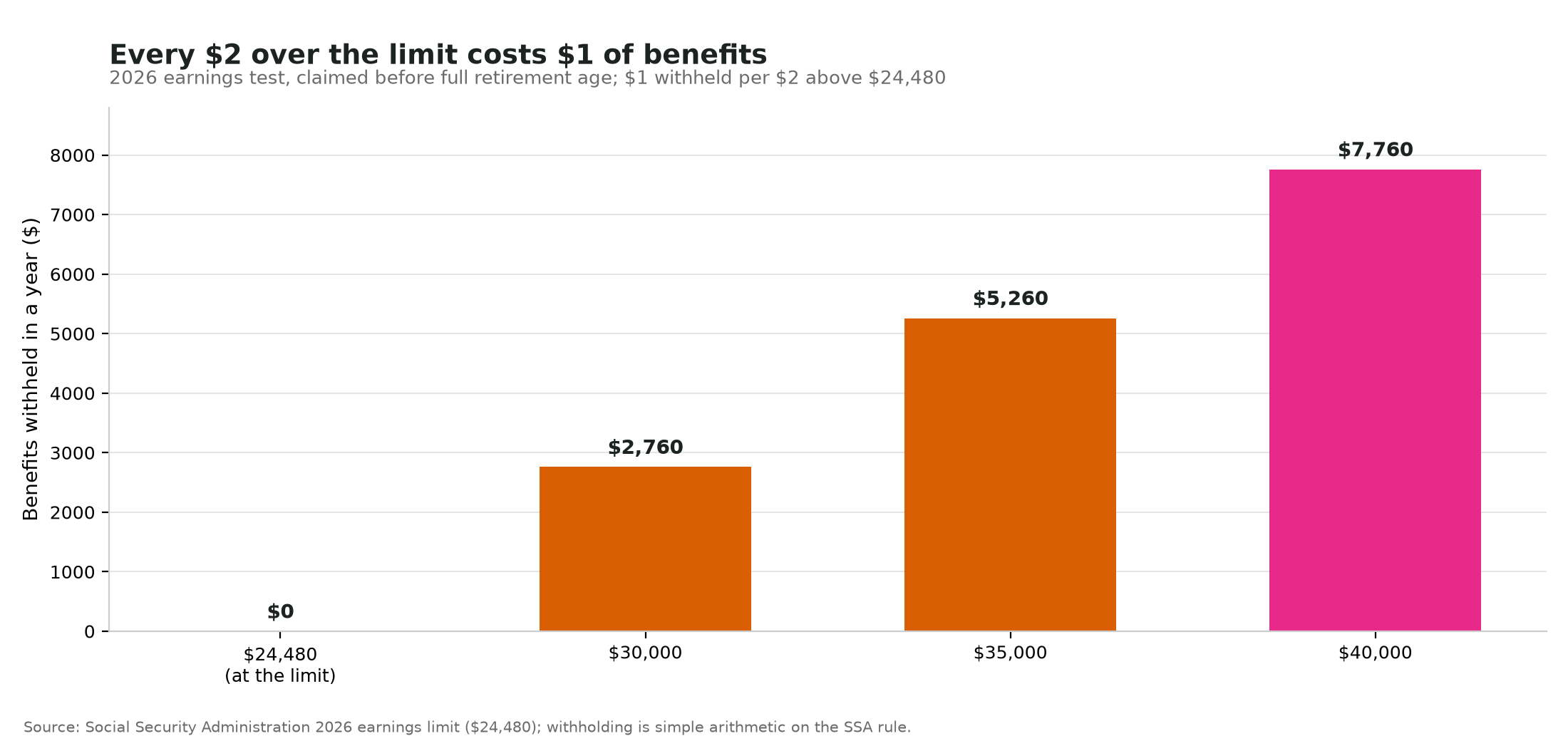 Withholding under the 2026 test for someone under full retirement age all year. Source: Social Security Administration 2026 limit of $24,480; amounts are arithmetic on the $1-per-$2 rule.
Run your own number before you take the shift
The calculation takes one minute. Take your expected 2026 wages, subtract $24,480, and divide by two. That is what SSA withholds. Earn $30,000 and the excess is $5,520, so $2,760 is withheld, roughly one typical monthly check for many beneficiaries. Earn $35,000 and $5,260 is withheld. SSA does not trim each check by a percentage; it typically withholds entire monthly checks at the start of the year until the withheld total is covered, which is why people get a frightening $0 check in January or February and assume something broke. Nothing broke. That is the mechanism, and knowing it in October lets you budget for it instead of being ambushed by it.
Withheld is not lost, and that changes the decision
Here is the part most coverage skips. Benefits withheld under the earnings test are not gone forever. When you reach full retirement age, SSA recalculates your benefit upward to credit back the months in which checks were withheld, per the agency's published explanation of the rule. In effect, the test defers part of your benefit rather than taxing it away. That does not make crossing the limit free: you still lose the cash flow now, and if you were counting on the check for monthly bills, a string of $0 checks is a real problem. But it does mean the decision about extra work is a timing question, not a penalty question. If the job pays well and you can bridge a few months without the check, the long-run math is usually kinder than the scary headline suggests.
What I would do this month
First, add up your gross wages through September and project the rest of the year honestly, including overtime and bonuses. Second, compare the total with $24,480, or $65,160 if this is your full-retirement-age year. Third, if you will cross it, decide now whether to trim hours or to accept withheld checks and plan the bridge. Fourth, tell SSA your expected earnings if they change materially; the agency reconciles after the year ends, and unreported overages become overpayment notices later. None of this requires an advisor. It requires one honest projection in October instead of a surprise in January.
FAQ
What is the Social Security earnings limit for 2026? $24,480 if you are under full retirement age all year, and $65,160 in the year you reach full retirement age, according to the Social Security Administration.
How much is withheld if I earn $35,000 in 2026? $5,260. The excess over $24,480 is $10,520, and SSA withholds $1 for every $2 of excess, per the agency's rule.
Do pensions or investment income count toward the earnings test? No. SSA counts wages and net self-employment income; pensions, investment earnings, and retirement-account withdrawals do not count, per SSA guidance.
Are withheld benefits lost forever? No. At full retirement age, SSA recalculates your benefit to credit the months when benefits were withheld, according to the agency's published explanation.
What happens at full retirement age? The earnings test stops. From the month you reach full retirement age, you can earn any amount with no withholding, per SSA.
Get the newsletter
New articles and the occasional deep dive. No spam.
Unsubscribe anytime. We never sell your email.