2027 401(k) Limit Projected at $25,500: Plan Now
The IRS has not announced the 2027 retirement limits yet, and anyone who tells you the numbers are official is ahead of the evidence. What we do have is a serious projection. Milliman, the actuarial firm whose forecasts use the same statutory rounding rules the IRS applies, projected on September 11, 2026 that the 2027 employee 401(k) limit will rise to 25,500 dollars, up 1,000 dollars from the official 2026 limit of 24,500 dollars. The final input to the calculation, September inflation, was released October 14, so the official IRS announcement is expected in the coming weeks. Here is how I plan around a projection without pretending it is a rule.
The full table: official 2026 vs. projected 2027
The 2026 figures are official, from IRS Notice 2025-67. The 2027 figures are Milliman's September 11 projection as compiled by The Finance Buff's 2026-2027 limits table and the GetMoneyNest summary of the 2027 limits, with one exception noted below: the 2027 HSA limits are already official.
| Limit | 2026 official | 2027 | Status |
|---|---|---|---|
| 401(k) elective deferral | 24,500 dollars | 25,500 dollars | Projected |
| Catch-up, age 50+ | 8,000 dollars | 8,500 dollars | Projected |
| Super catch-up, ages 60-63 | 11,250 dollars | 11,750 dollars | Projected |
| Total additions (415c) | 72,000 dollars | 75,000 dollars | Projected |
| Compensation cap | 360,000 dollars | 375,000 dollars | Projected |
| IRA contribution | 7,500 dollars | 7,500 dollars | Projected flat |
| HSA, self-only | 4,400 dollars | 4,500 dollars | 2027 official |
| HSA, family | 8,750 dollars | 9,000 dollars | 2027 official |
| Health FSA | 3,400 dollars | 3,500 dollars | Projected |
Two details deserve emphasis. First, the IRA limit is projected to stay flat at 7,500 dollars, so do not budget an increase that is not coming. Second, the HSA numbers are not a projection: the 2027 HSA limits of 4,500 dollars self-only and 9,000 dollars family are official, from IRS Revenue Procedure 2026-24, as the GetMoneyNest compilation notes. If your open enrollment is open now, you can elect against those two today.
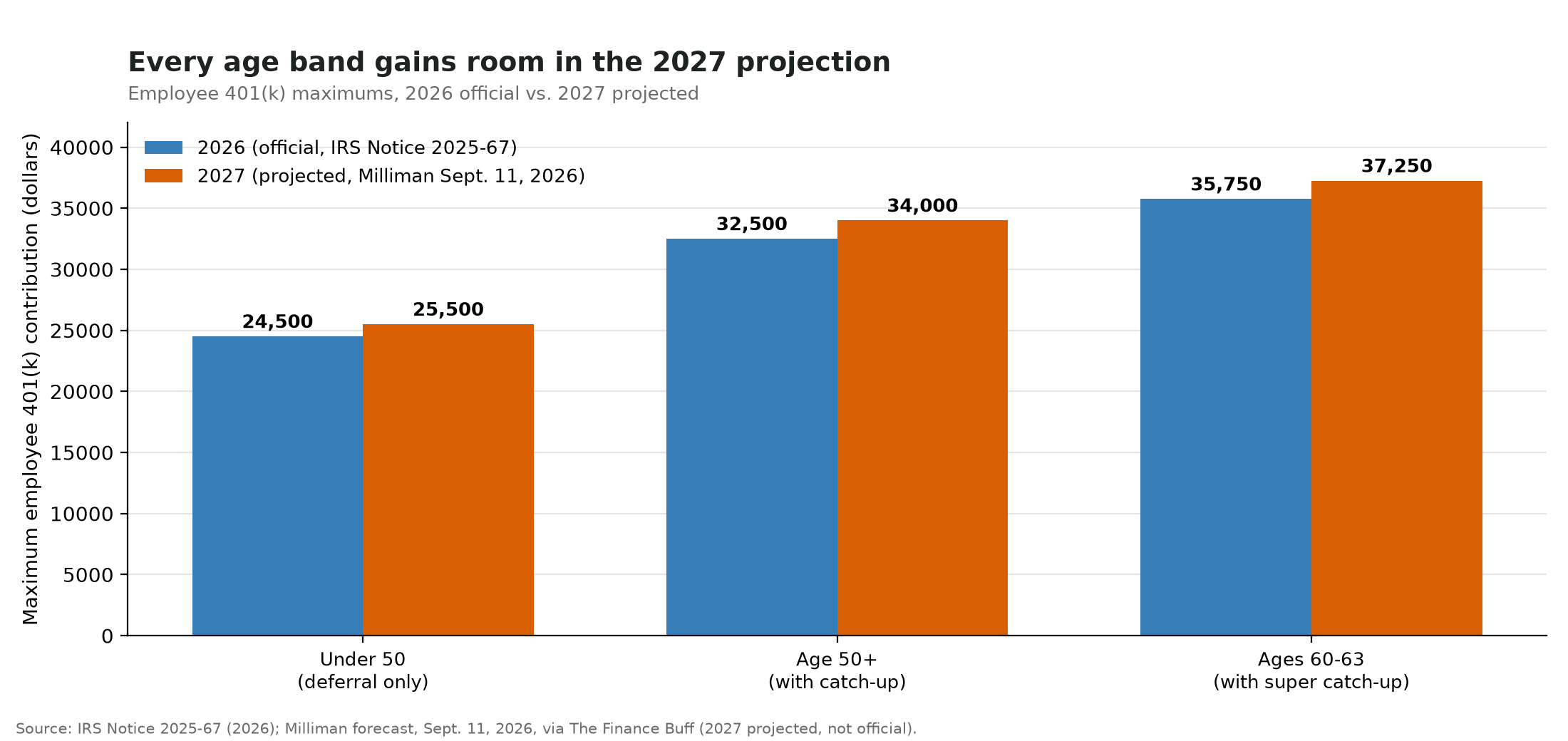 Maximum employee contributions by age band. The 50-plus total is the deferral plus the standard catch-up; the 60-63 total uses the SECURE 2.0 super catch-up. Sources: IRS Notice 2025-67; Milliman projection, September 11, 2026.
The per-paycheck math, worked in full
A limit increase only helps if your election actually rises. Most people set a percentage in January and never touch it, which is why I do this arithmetic every October, the same month I check my 401(k) catch-up rate.
If the projection holds and you are paid every two weeks (26 paychecks):
- 2026 maximum: 24,500 / 26 = 942.31 dollars per paycheck
- 2027 maximum: 25,500 / 26 = 980.77 dollars per paycheck
- Difference: 38.46 dollars per paycheck, 1,000 dollars over the year
If you are paid monthly, the 2027 maximum is 2,125 dollars a month against 2,041.67 dollars in 2026, a difference of 83.33 dollars. For a saver age 50 or older maxing both the deferral and the projected catch-up, the 2027 total is 34,000 dollars, which is 1,307.69 dollars per biweekly paycheck. I am not arguing everyone should max. I am arguing that if maxing is your plan, a stale election quietly under-saves you by exactly the increase.
What to do now, and what to wait on
Do now: run the paycheck math for your pay frequency, check whether your plan lets you schedule a January election change today, and set your HSA election if your employer uses the official 2027 limits. This pairs naturally with the FSA versus HSA open enrollment math, since both elections lock at the same time.
Wait on: changing your 401(k) percentage itself until the IRS confirms the 2027 figures and your plan administrator adopts them, which is also the advice in Considerable's explainer on the projected 25,500 dollar limit. Plans cannot accept deferrals above the official limit, and an election built on a projection can overshoot if the final rounding lands lower. The projection has been reliable in past cycles because Milliman works from the same formula and most of the same inflation data, but reliable is not official.
One more interaction to check before year-end: if you are also weighing a Roth conversion to fill your current bracket, do that math on 2026 rules before December 31. The 2027 projection changes next year's saving room. It changes nothing about this year's conversion deadline.
Get the newsletter
New articles and the occasional deep dive. No spam.
Unsubscribe anytime. We never sell your email.